MACROVANTA - Signal #001: The End of ZIRP and the Death of Freemium B2C
Higher rates and subscription fatigue changed the math behind free users.
MACROVANTA 2026-06-23
Signal #001 · The End of ZIRP and the Death of Freemium B2C
 
Free users can be worth 20-40% less than your 2021 spreadsheet says.
8 min read · pricing
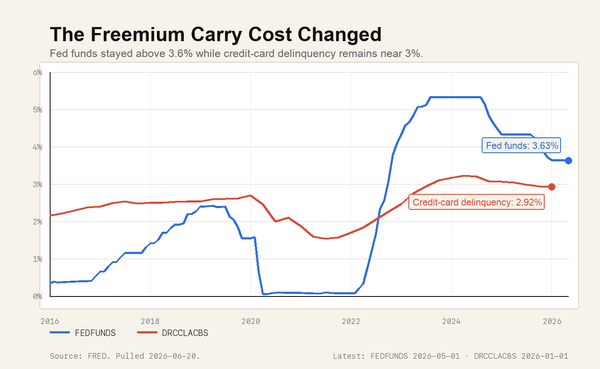
The Freemium Carry Cost Changed chart showing fed funds and credit-card delinquency rates from 2016 through 2026
Caption: Fed funds is 3.63% as of May 2026, while credit-card delinquency is 2.92% as of Q1 2026. Both inputs make delayed free-to-paid revenue less forgiving than it was in the ZIRP era.
The Macro Shift

Two series anchor this issue.

The Federal Funds Effective Rate (FEDFUNDS) is 3.63% as of May 2026. That is down from the 2023-2024 peak, but still far above the 0-0.25% floor that defined the freemium decade. A free user who might convert in month 9, 12, or 18 is no longer sitting in a zero-rate spreadsheet. Future revenue has a real carry cost.

The Delinquency Rate on Credit Card Loans (DRCCLACBS) is the second input. It peaked above 3% in 2023-2024 and is 2.92% as of Q1 2026, roughly double its 2021 low. Revolving consumer credit (REVOLSL, from the Fed's G.19 release) is about $1.35T as of April 2026. Households have more revolving debt, higher debt-service pressure than the ZIRP period, and less tolerance for recurring charges that do not prove themselves quickly.

Two inputs to the freemium LTV calculation moved against the operator at the same time: the discount rate on future revenue and the buyer's willingness to keep paying for low-urgency subscriptions.

That does not mean every freemium model is dead. It means the old default - acquire a large free base, wait months for a small paid conversion rate, and assume retention will clean up the math - needs to be re-run with 2026 inputs.

The Old Math vs. The New Math

The 2021 model was simple: acquire as many free users as possible, keep friction low, and let time do the monetization work. If capital was cheap, a long payback window did not feel dangerous. If consumers were still adding subscriptions, a $5-20 monthly upgrade felt like a rounding error. If paid channels were efficient, a large free top of funnel felt like an asset even when most users never converted.

The 2026 model is less forgiving. CAC has to pay back faster. A delayed conversion is worth less than an immediate dollar. A low-priced subscription has to survive an audit next to banking apps, AI tools, streaming bundles, cloud storage, and every other recurring charge. The product still has to be good, but now the pricing model has to prove urgency much earlier.

This is the core operator question: does your free tier create economic momentum, or does it just postpone the pricing conversation?

The Micro Impact

If you build SaaS, indie consumer apps, or B2B micro-tools, the freemium math you internalized in 2018 is now wrong in three specific ways.

1. The LTV of a free user fell before you even touch conversion.

The standard pitch was: give it away, watch them love it, convert 3-5% in months 6-12, recoup through retention. That math worked best when money was nearly free and CAC payback could be patient. At today's rate environment, delayed paid revenue should be discounted. The hit is not always huge by itself, but it is enough to expose funnels that were already thin.

For an indie B2C app, this is where the leak hides. A user signs up free, plays with the product twice, ignores three lifecycle emails, then maybe converts nine months later during a promotion. Your dashboard still counts that signup as a potential future customer. Your bank account experiences it as hosting cost, support surface area, and distraction.

2. Free-to-paid lag is now the hidden tax.

The real damage comes when a higher discount rate meets a longer conversion lag. A free signup that converts after 3 months and a free signup that converts after 14 months are not the same asset. The second one consumes product support, infrastructure, onboarding surface area, and analytics attention long before it pays you.

Under common freemium assumptions - 3-5% free-to-paid conversion, 6-12 months of lag, $15-30 monthly ARPU, 3-6% monthly churn, and nonzero CAC - the effective value of a free user can fall 20-40% versus a 2021-style model. You do not notice because the old spreadsheet still treats a future paid user like a near-certain asset.

For a prosumer tool, the audit risk is the real problem. The user may like the product, but if the value is vague, the subscription is easy to cut. A $9 writing helper, $12 dashboard, or $19 productivity app has to answer a harsher question than it did three years ago: what did this save me this week?

3. B2B micro-SaaS can often charge earlier than consumer software.

This is the opportunity hidden inside the pressure. A manager with a budget problem does not need a massive platform; they need one workflow fixed. If your tool replaces a junior analyst task, reconciles a messy spreadsheet, flags a revenue leak, or turns a manual report into a repeatable process, free may be the wrong signal.

In that setting, a refundable paid trial can beat a free tier because it qualifies intent immediately. The user either believes the pain is real enough to put a card down, or they do not. That is cleaner data than watching a large free cohort drift through onboarding.

The compound effect on a typical indie funnel: free-user LTV is overstated, CAC payback takes too long, and the product team keeps optimizing activation for users who may never become buyers.

The Tactical Move

Three moves this week. None take more than an afternoon.

  1. Reprice your free user. Open your funnel data. Compute today's free-to-paid lag in months and your most recent paid ARPU. Discount the expected paid revenue at a realistic annual rate, then compare that present value to your blended CAC. If CAC exceeds discounted LTV, every free signup is a loss until proven otherwise.
  2. Test a refundable paid trial against the free tier. Charge the card on day one. Make the refund path clear. This filters non-buyers in week one instead of month nine and gives you a real CAC denominator within days instead of a year.
  3. Rewrite the hero around measurable first-session ROI. Not "try free." Not "no credit card required." A specific outcome the user can verify quickly: "Find 3 unpaid invoices in 5 minutes." "See your top 5 ad-spend leaks today." Specificity is the conversion lever; free is just a pricing mechanic.

Use this decision rule:

  • Keep freemium if free users create measurable activation, referrals, network effects, data advantages, or enterprise expansion.
  • Test paid trial if CAC is nonzero, usage has immediate ROI, or free-to-paid conversion takes longer than 6 months.
  • Kill the free tier if support, compute, onboarding, or analytics complexity is rising faster than paid conversion.

Success signal: your first cohort of 7-day paid trials shows a refund rate under 30% and 14-day retention above 50%. At those thresholds, the paid trial often generates more immediate cash per acquired user than the freemium funnel it replaces.

The Operator Asset
Anti-Freemium Pricing Calculator
I built a Google-Sheets-ready calculator that compares your current freemium funnel against a refundable paid trial.
Inputs: free signups, free-to-paid conversion, conversion lag, ARPU, gross margin, churn, CAC, discount rate, paid-trial price, trial conversion, and refund rate.
Outputs: discounted free-signup LTV, CAC payback, paid-trial immediate EV, retained paid-user value, breakeven conversion, and a recommendation.

Thursday I'll send the calculator so you can run this against your own funnel. The point of today's issue is the strategic decision: if delayed conversion is now expensive, your pricing model has to prove itself faster.

 
Source Stack
· FRED - Federal Funds Effective Rate (FEDFUNDS)
· FRED - Credit Card Delinquency Rate (DRCCLACBS)
· FRED - Revolving Consumer Credit (REVOLSL)
· Fed - G.19 Consumer Credit release
· NY Fed - Household Debt and Credit Report
 
Big shifts. Practical moves.
Forwarded this? Subscribe to Macrovanta.

Keep Reading